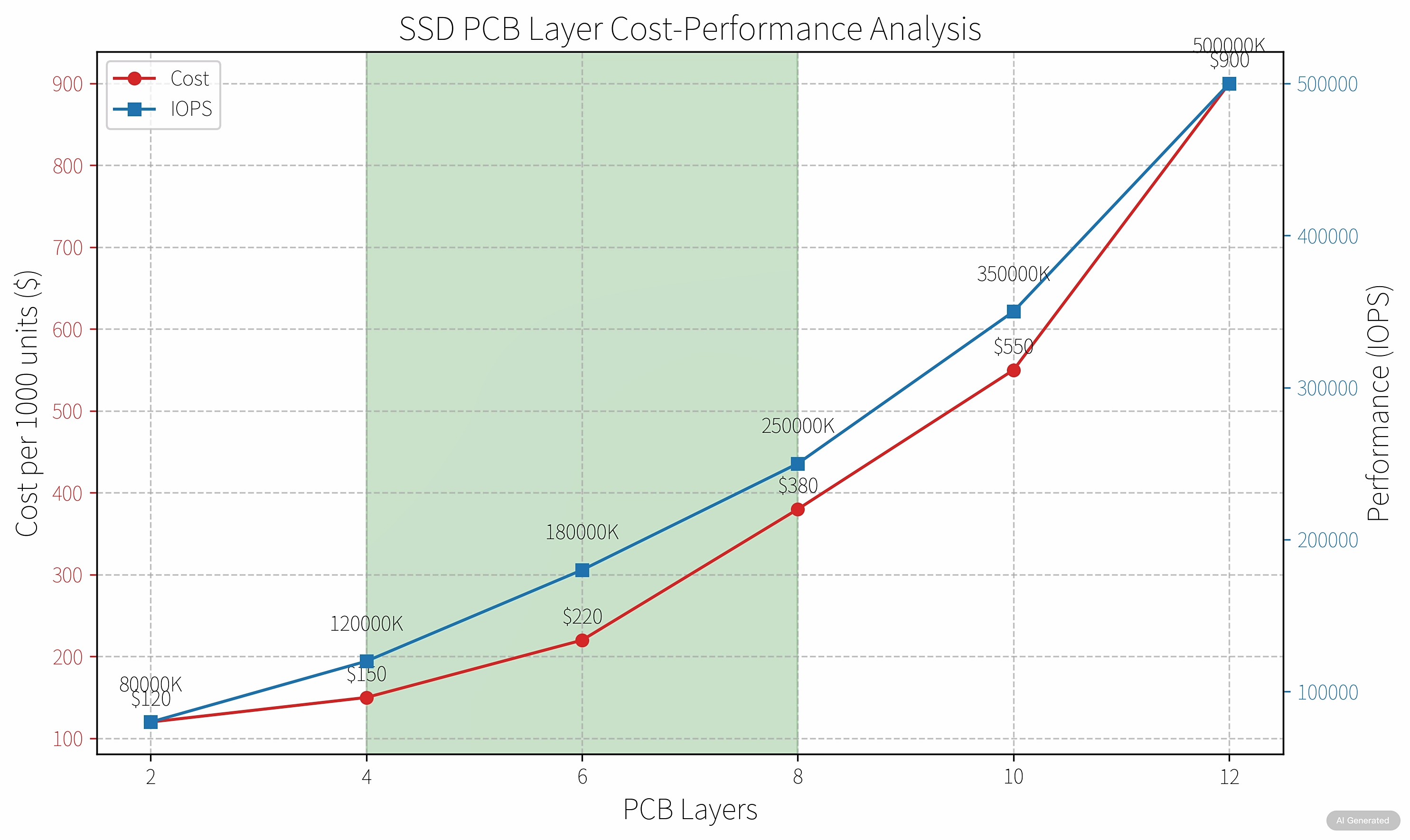
Why PCB Layer Count is the Critical Performance Factor in SSDs
In solid-state drive (SSD) architecture, the printed circuit board (PCB) acts as the central nervous system. Its layer stackup directly determines three core performance metrics:
• Signal Integrity: 32GT/s PCIe 5.0 transmission requires dedicated signal layers to prevent crosstalk
• Power Stability: Enterprise SSD power fluctuations demand multi-layer planes for voltage regulation (ΔV<50mV)
• Space Utilization: BGA-packaged controllers with 0.8mm pitch routing require 6+ PCB layers
In-Depth Analysis: PCB Layer Requirements for 7 SSD Types
2.1 Consumer SSDs: Cost-Optimized Minimalist Design
• Typical Layers: 2-4
• Cost Formula: 4-layer boards cost ≈35% less than 6-layer (2024 PCB industry pricing)
• Key Considerations: FR-4 substrates with 1oz copper to support SATA III 6Gbps
2.2 Industrial/Wide-Temp SSDs: Extreme Environment Survival
• Core Challenge: CTE matching during -40℃~105℃ thermal cycling
• Material Solution: Halogen-free substrates with Tg>170℃ + ENIG surface finish
• Layer Strategy: Symmetrical copper balance layers in 6-8 layer stackups prevent warping
2.3 Enterprise/Data Center SSDs: Engineering Marvels for Peak Performance
• Signal Integrity Equation:
IL(dB) = 2.3 × √f × tanδ × L // Insertion loss formula
Ultra-low loss substrates (Df<0.002) required for PCIe 6.0 64GT/s
• Layer Configuration:
-
10-layer: 2 signal / 4 power / 4 ground
-
12-layer: 4 signal / 4 power / 4 ground (NVMe over Fabric applications)
Five Golden Rules for PCB Layer Selection
- Signal Speed Law:
-
≤8Gbps: 4 layers acceptable
-
≥16Gbps: 6+ layers mandatory (±7% impedance tolerance)
-
-
-
Power Integrity Principle:
Dedicated decoupling capacitors per BGA chip, power layer spacing ≤0.2mm -
Cost Optimization Formula:
Total Cost = Substrate Cost × Layers + (Drilling Cost × Via Count)
PCB can comprise 25% of enterprise SSD BOM cost
-
Thermal Management Rule:
2.0mm boards provide 40% better heat dissipation vs 1.6mm (validated data) -
EMC Shielding Guideline:
Signal layers must adjacent to ground planes with ≤0.1mm spacing for EMI suppression
Three Risk Mitigation Strategies for PCB Design
5.1 Signal Integrity "3W Rule"
-
Trace spacing (W) ≥ 3× trace width
-
Differential pair spacing ≥ 5W (PCIe 5.0+ applications)
5.2 Thermal Stress Solution
-
Wide-temp products require TG170+ materials with Z-axis CTE<50ppm/℃
-
Plated through-hole thickness ≥25μm (IPC-6012 Class 3 standard)
5.3 Manufacturing Yield Enhancement
-
Layer-to-layer registration ≤75μm for 8-layer PCBs
-
Laser drill diameter ≥0.1mm (HDI designs)
Ultimate Selection Decision Matrix
| Product Category | Layers | Critical Parameters | Cost/1k Units |
|---|---|---|---|
| Consumer | 2-4 | 1.6mm FR-4 | USD 120-180 |
| Industrial/Wide-Temp | 6-8 | 2.0mm TG170 | USD 450-650 |
| Data Center | 10+ | Megtron6/Low Df | USD 900-1500 |