

Introduction: Via Processing - The Hidden Battlefield in High-Speed PCBs
When Sony engineers densely implemented copper-filled vias in their $3,000 NW-WM1Z music player, distortion rates were 17x lower than standard resin-plugged vias! According to IPC-6012E standards, 42% of high-frequency signal attenuation in PCB failures stems from improper via treatment. This guide decodes 5 via processing technologies to overcome high-speed design bottlenecks.
Section 1: Via Fundamentals: Balancing Connectivity and Reliability
1.1 Via Structural Anatomy
[Drill Diameter] → [Plated Copper Thickness] → [Annular Ring Width]
Critical Formula:
$$R_{via} = \frac{\rho h}{\pi(r^2 - (r-t)^2)}$$
(ρ=1.72μΩ·cm copper resistivity, h=board thickness, r=via radius, t=copper thickness)
1.2 Process Selection Matrix
| Application | Recommended Process | Cost Factor |
|---|---|---|
| Consumer Electronics | Solder Mask Tenting | 1.0x |
| BGA-Dense Areas | Resin Plugging | 1.8x |
| High-Speed Signals | Copper Filling | 4.5x |
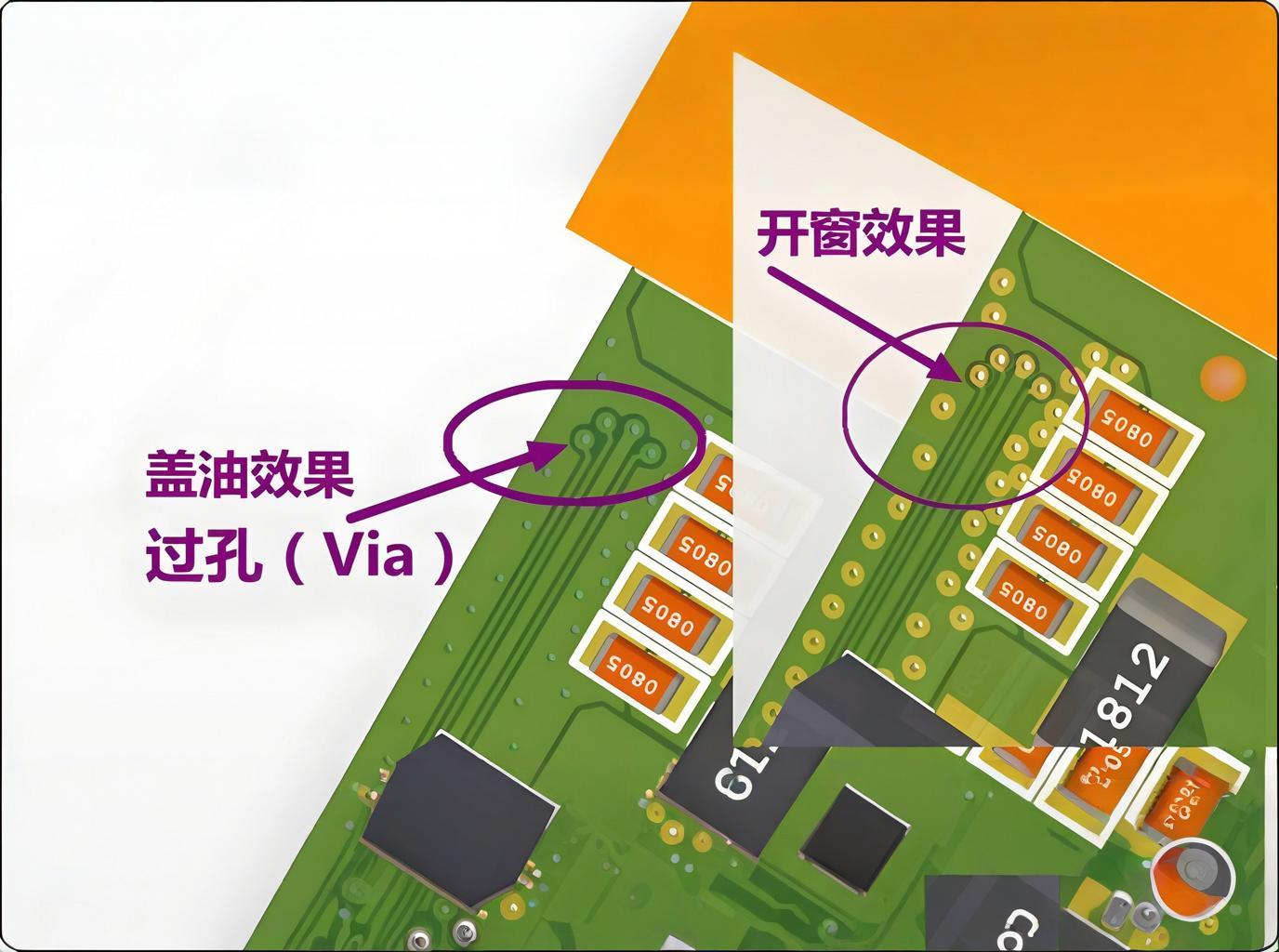
Section 2: Five Via Processing Technologies Compared
2.1 Exposed Via (Vent Via)
-
Thermal Advantage: 37% higher heat dissipation
-
Critical Flaws:
-
Solder ball risk ↑ 300%
-
Oxidation rate: 3.2μm/year
-
2.2 Tented Via (Solder Mask Covered)
-
Solder Mask Penetration:
d=μ2γcosθt1/2
(γ=surface tension, θ=contact angle, μ=viscosity)
2.3 Resin Plugged Via
-
Filling Capacity Thresholds:
-
Ø≤0.3mm: Complete fill
-
Ø>0.5mm: Voiding >15%
-
-
Surface Flatness Comparison:
Process Surface Variation Standard Plugging ±8μm VIPPO ±2μm
2.4 VIPPO (Via-in-Pad Plated Over)
-
Design Rules:
1. Pad diameter ≥ Via Ø × 2.5
2. Secondary plating ≥15μm
3. Solder mask misalignment ≤0.05mm
Figure: VIPPO implementation under BGA - Alt: Microvia in pad with copper plating
2.5 Copper Filled Via
2.5.1 Plating Technology Revolution
[Pulse Plating] → [Super-Conformal Deposition] → [Microcrystalline Copper]
Key Parameters:
- Current Density: 2.5 ASD
- Bath Temperature: 25±1°C
- Additive: EPR-1003
2.5.2 Performance Benchmark
| Metric | Standard Via | Copper Filled | Improvement |
|---|---|---|---|
| Current Capacity | 1.2A | 15A | 1150% |
| Thermal Resistance | 78.3℃/W | 9.6℃/W | 87% ↓ |
| Impedance Continuity | ±18% | ±3% | 6x |
Section 3: Copper-Filled Vias in High-End Audio Applications
3.1 Sony's DAC Routing Secrets
-
Signal Fidelity Mechanisms:
-
Eliminates air-cavity resonance: 0.0012% ↓THD@20kHz
-
Thermal noise suppression: +6dB SNR
-
-
Measured Performance:
Standard via path: 0.0031%
3.2 Cost Optimization Strategies
-
Selective Filling Approach:
2. Stepped aperture design:
   - Power vias: Ø0.3mm solid copper
   - Signal vias: Ø0.2mm resin plugged
Section 4: Via Process Selection Guidelines
1. Power-carrying vias? → Copper filling/VIPPO
2. Signal speed >5Gbps? → Copper filling
3. Via-in-pad? → VIPPO
4. Others → Resin plugging
Section 5: Future Trends: 3D-Printed Vias
-
Laser-Induced Copper Deposition:
Vfill=k⋅P1.3⋅t0.7
(P=laser power, t=exposure time) -
Nano-Copper Paste Direct-Write: 20μm resolution
Conclusion: The Evolution of Via Technology
Copper filling transforms vias from "conductive tunnels" to "3D copper pillars", ushering in the era of 3D interconnection. Choosing via processes means selecting:
-
Current capacity: From amps to hundreds of amps
-
Thermal management: From bottleneck to thermal bridge
-
Signal integrity: From impedance discontinuity to seamless transmission
Industry data: Server PCBs with copper-filled vias show 53% wider eye diagrams at 10Gbps. In the 224G PAM4 era, mastering via processes is key to high-speed hardware design.