

In the era of miniaturized electronics and high-power applications, high-current PCB design has become a critical challenge for engineers. When conventional designs falter at 150A currents, how can we overcome physical limits for stable power delivery? This in-depth analysis reveals cutting-edge solutions and core technologies!
? Physics of Current Carrying Capacity & PCB Limitations
PCB current handling is fundamentally constrained by conductor resistance and thermal management efficiency. According to Joule's Law (Q = I²·R·t), current doubling causes quadratic heat generation. At 150A+, designers face three critical challenges:
-
Copper foil heating: Even with 2oz copper (70μm), a 10cm-long, 100mil-wide trace at 150A experiences >85°C temperature rise
-
Substrate thermal limits: Standard FR4's glass transition temperature (Tg) of 140-170°C causes layer deformation
-
Electromigration risk: At current densities >500A/cm², copper ion migration may cause open circuits (Source: IPC-2152)

⚡ Deep Dive: Traditional High-Current Design Methods
Scientific Basis of Trace Width Calculation
The "1A/1mm" rule (IPC-2221) requires refinement using the modified formula:
I = k \cdot \Delta T^{0.44} \cdot A^{0.725}
Where *k* = material constant (0.048 outer / 0.024 inner layers), ΔT = allowable temperature rise, A = cross-sectional area (mm²). For 150A, trace width must reach 40mm (≈1600mil)!
Copper Thickness Multiplier Effect
Current capacity increases nonlinearly with copper weight:
| Thickness (oz) | Relative Ampacity | Required Width for 150A |
|---|---|---|
| 1 | Baseline | 80mm |
| 2 | 180% | 44mm |
| 3 | 240% | 33mm |
The Solder Mask Opening Paradox
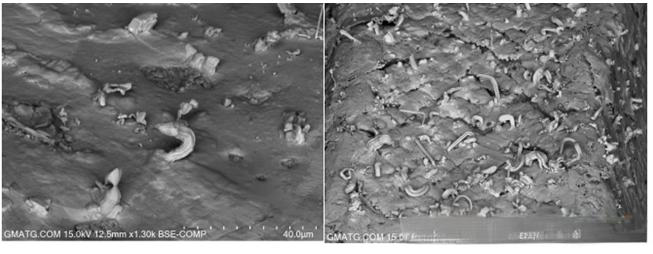
Despite solder's lower resistivity (11.5×10⁻⁸Ω·m vs copper's 1.68×10⁻⁸Ω·m):
-
Interfacial contact resistance increases 30-50%
-
CTE mismatch (Cu: 17ppm/°C vs Sn: 23ppm/°C)
-
Tin whisker risk (JEDEC JESD22-A121A)
⚠️ Five Critical Failure Modes in 150A Designs
-
Thermal runaway: Hotspots reach 2× average temperature (e.g., 180°C hotspot at 120A on 3oz copper)
-
Z-axis expansion: Tg150 substrates exhibit 300ppm/°C CTE at 140°C causing via fractures
-
Solder migration: Sn63Pb37 softens at 183°C (melting at 213°C)
-
Galvanic corrosion: 5× accelerated corrosion in humid environments
-
Mechanical fatigue: 70% reduced vibration tolerance at solder-filled areas
? Innovative High-Current Solutions Handbook
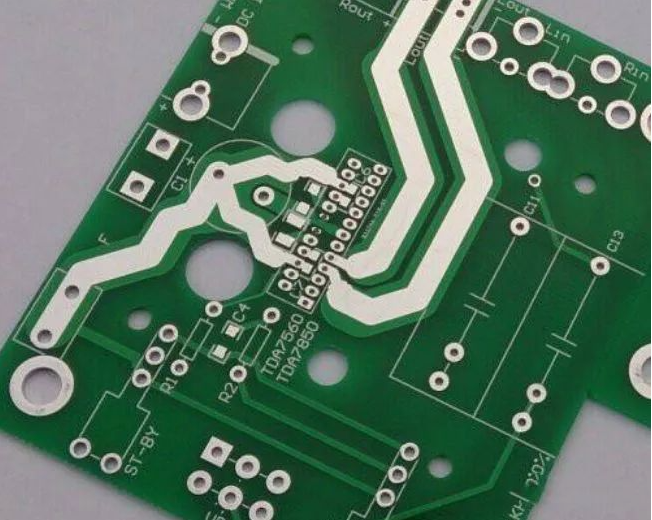
Embedded Busbar Integration (Optimal Solution)
R_{total} = R_{cu} + R_{interface} + R_{pcb}
Key parameters:
-
Busbar size: 3mm × 30mm (90mm² cross-section)
-
Current density: 1.67A/mm² at 150A
-
Interconnect: Laser micro-welding (<0.1mΩ contact resistance)
Multilayer Current Matrix Design
Distributed current layer technology:
-
Dedicated power layer: 2oz Cu + 0.5mm dielectric
-
Via array: Φ0.3mm vias in 5×5 grid
-
Thermal balancing algorithm:
\Delta T = P \cdot R_{\theta} \quad P = I^2 \cdot (R_{cu} + N \cdot R_{via})
Where N = parallel vias, Rθ = thermal resistance
Advanced Metal-Core PCB Applications
| Parameter | FR4 | MCPCB | Improvement |
|---|---|---|---|
| Thermal conductivity | 0.3 W/mK | 2-8 W/mK | 7-26× |
| Thermal resistance | 20 °C/W | 1.5-3 °C/W | 85% ↓ |
| Current capacity | Baseline | 200% | 2× |
Breakthrough: Copper-aluminum composite substrate (400W/mK) with microchannel cooling: <40°C rise at 250A!
? Golden Rules for High-Current PCB Design
-
Current density limits: ≤5A/mm² (outer), ≤3A/mm² (inner) per MIL-PRF-31032
-
Thermal design triad:
-
≥10cm² heat dissipation per 100A
-
<15°C hotspot differential
-
ANSYS Icepak® thermal validation
-
-
Material selection matrix:
Current >100A? → Yes → Duration >1min? → Yes → BUS-BAR
                                  ↓ No → 3oz+ MCPCB
                ↓ No → Standard 2oz design
? Future Trends: Superconductive PCB Technology
Laboratory breakthroughs:
-
Niobium nitride (NbN) films: Critical current density = 10⁶A/cm² (1000× room-temp copper)
-
Graphene substrates: Thermal conductivity = 5300 W/mK, ρ = 10⁻⁶Ω·cm
-
Microchannel LN₂ cooling: 100× traditional cooling efficiency
Through the integration of materials science, thermodynamics, and innovative structures, modern PCBs have shattered the 150A barrier. Master these core technologies to achieve revolutionary improvements in power electronics reliability!